

Published | Updated
By Inez Spring Park Management.
Somebody in your family just typed we should all get together this year into the group chat. Forty messages later there is no date, no place, and one aunt has gone quiet in a way everybody noticed. If you're searching for how to plan a family reunion, that group chat is probably why.
Here's how to plan a family reunion, the short version from the other side of a front desk: three decisions locked in the first two weeks, then a countdown anyone can run. The families who pull it off aren't more organized than yours. They decide in a different order, and they dodge a dates trap that kills more reunions than money ever does, which we'll get to.
Quick answer: To plan a family reunion, lock three things 90 days out: the date (offer 3 weekends, close the vote in 7 days), the headquarters venue, and a per-head budget. Then run a 90-60-30 countdown: book lodging by day 60, assign one job per household by day 45, collect money and the final headcount by day 30, and confirm food and a rain plan in the final week.
The failure pattern is always the same. Someone floats the idea in March and everyone says yes. Nobody owns it, so by June the thread is 200 messages of whatever works for everybody, and by August the reunion has quietly become maybe next year.
The problem isn't your family. Consensus planning treats every decision as open forever, and open decisions rot. Money pressure makes it worse: Deloitte's 2026 summer travel survey found 32 percent of people skipping summer travel said it was too expensive right now. An open-ended plan with no price on it gives every cousin a reason to wait.
Most advice on how to plan a family reunion starts with themes, matching t-shirts, and slideshow apps. That's backwards. A t-shirt has never saved a reunion. A locked date has saved plenty.
We call it the 90-Day Reunion Countdown: three phases, one decider, one job per household. It runs on one idea, that every decision closes on a deadline, and the whole thing fits in a notes app. If you keep one thing from this guide, keep the countdown.
Name the decider. That's you, apparently. Not a committee: one person gathers input, sets deadlines, and makes the call. Announce it plainly, because unowned reunions stay imaginary.
Kill the dates trap. The trap is waiting for a date that works for everyone, and that date does not exist in any family bigger than six. Offer exactly 3 weekends, run a 7-day vote, majority wins, no revote. Better to have most of the family there than all of the family still texting in October.
Set the per-head budget before the venue. Pick a number the schoolteacher cousin can say yes to without wincing. For lodging in a shared format, about $27 to $40 per person per night works for 10 to 25 people, and the budget section below shows the math.
Book the venue sooner than feels reasonable. RVshare's holiday booking analysis puts the average lead time at about 64 days for July 4, 61 for Memorial Day, and 74 for Labor Day. That's single families. Your group needs more runway, so the vote needs a deadline and the venue needs a deposit.
Send one email, not a text. It carries the locked date, the venue, the per-head cost, and a booking deadline 14 days out. A deadline with a consequence, like after the 15th we release the held sites, beats six reminders.
Assign one job per household this month. There's a whole section on that rule below, because it's the difference between hosting a reunion and being its unpaid staff.
Draft the schedule now and keep it thin: two anchor events a day, everything else open. Over-planned reunions feel like conferences. Half of learning how to plan a family reunion is deciding what not to schedule.
The last 30 days are confirmations, not decisions. If you're still deciding things in the final month, go back one phase and lock them. Also ask any venue how it handles late arrivals. Ours sends an emailed gate code, because reunion families trickle in from three cities and the 11 PM cousin is a tradition of his own.
This is how to plan a family reunion on one page: twelve lines, one owner column, zero binders. A reunion checklist only works when every line has a name on it, so fill the owner column first. Copy it into your notes app and it's yours.
| When | Task | Owner |
|---|---|---|
| Day 90 | Name the decider, open the 3-date vote | You |
| Day 83 | Close the vote, lock the date | You |
| Day 80 | Set the per-head budget (about $27 to $40 a night for lodging) | You |
| Day 75 | Pick the venue, put down the deposit | You |
| Day 60 | Send the one email: date, cost, booking deadline | You |
| Day 46 | Booking deadline hits, release unclaimed spots | You |
| Day 45 | Assign one job per household | You |
| Day 40 | Draft the schedule: two anchors a day, max | Schedule captain |
| Day 30 | Final headcount, collect the money | Money captain |
| Day 14 | One-page info sheet to everyone | You |
| Day 7 | Menus, coolers, and the ice run confirmed | Food captains |
| Day 1 | Print the schedule, pack the name tags | You |
Notice where the work sits. Seven of the twelve lines land before day 45. That front-loading is the reunion timeline that works, and it's why the last month feels calm instead of frantic.
Money fights are venue fights in disguise. One cousin's reasonable is another cousin's car payment. The fix isn't a cheaper reunion. It's comparing formats by per-head math instead of sticker price, in public, early.
| Format | Everyone under one roof? | Kitchen you control | Gathering space | The per-head problem |
|---|---|---|---|---|
| Hotel block plus restaurant back room | No, scattered by floor and wing | No | Rented by the hour | You pay per room whether the rooms are full or not |
| One big vacation rental | Only up to the bed count | Yes, one | The living room, if everyone fits | Fine to about 12, then the couch lottery starts, plus cleaning fees |
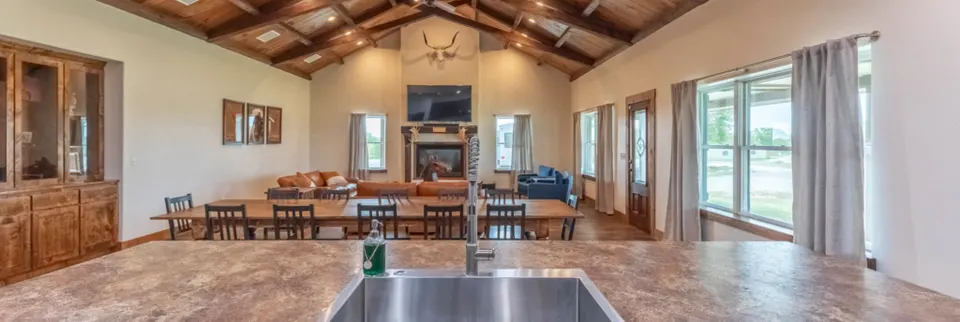
| RV park plus a group house as headquarters | Beds for some, private sites for the rest | Yes, plus grills | 24 acres, common space, private kayak launch | Lower per head as more households bring their own RV or tent |
That last band is our own math, not a brochure estimate. The barndominium sleeps 11 across 4 bedrooms and 4 bathrooms (see rates on the booking page), full-hookup RV sites start at $40, and tent sites start at about $31. RV and tent rates are published starting rates as of October 2026, before taxes, and rates vary on some weekends and holidays.
One worked example: a 16-person reunion with 11 people in the house, one RV household of 3, and two teens in a tent. For the RV and tent sites only, off-season weekend rates start at $40 and about $31 a night, respectively; see the booking page for barndominium rates. Post the lodging details in the group chat and the budget conversation is mostly over.
For more group sizes, from 10 to 25 people, plus named Texas state park halls priced the same way, see our breakdown of affordable family reunion locations.
Collect up front, never after. And post the math where everyone can see it, because when the sheet says lodging $30 a head, $60 for the weekend, the fairness argument ends before it starts. Nobody tells you this part, but knowing how to plan a family reunion is mostly knowing how to talk about money without flinching.
Delegation advice usually stops at ask for help. Useless. The One-Job Rule is specific: every household owns exactly one job, by name, in writing.
Two sentences make it stick: You own the photos. If it happens, it's because of you. People rise to named ownership and hide from group asks.
If you've ever run a potluck sign-up sheet, you already know this works. This is the weekend-sized version of the same move, and it's the part of reunion planning that keeps you from becoming the family martyr.
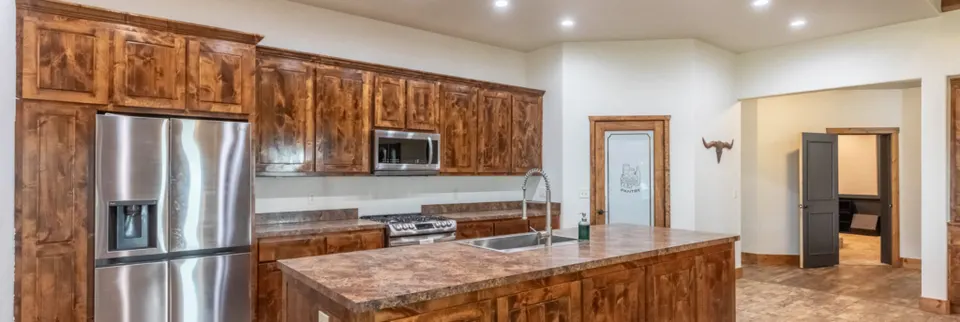
Meals sink more reunion budgets than lodging does, and restaurant logistics for 20 people are their own quiet misery. KOA's 2026 Camping and Outdoor Hospitality Report puts average daily spending per person, not counting accommodations, at over $200 in 2025. Food is a big share of that, and a kitchen is how you keep it.
One real kitchen changes the whole weekend. It's the quiet reason groups pick a headquarters that has one over a hotel where kitchen means a minibar.

Two questions decide most reunion venues: what does it cost per head, and where does grandma sleep. The second one is the harder test. Any answer to how to plan a family reunion has to survive the grandma question, because when the older generation isn't comfortable, they don't come.
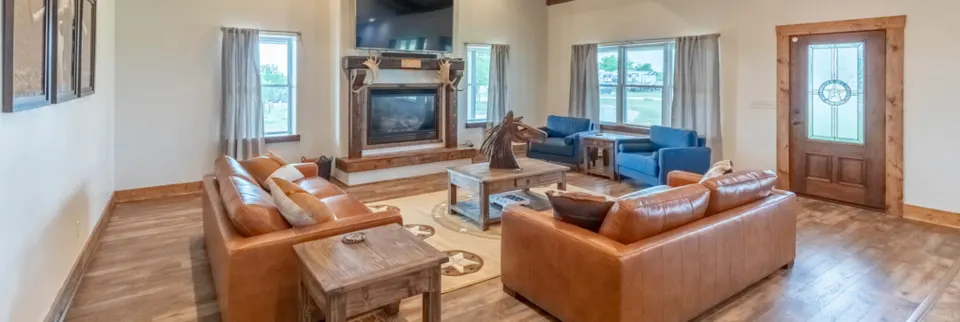
The layout that works: real beds and real bathrooms for the grandparent generation, doors that close for every household, and one shared space everybody drifts back to. That's the format we run on purpose: a 4-bedroom barndominium in the middle, more than 70 RV sites around it, and a private kayak launch on the Leon River.
The drive matters more than brochures admit. Pick the place that evens out everybody's miles, not the one closest to whoever is organizing. We sit at Exit 343 on I-20 in Eastland, about 2 hours west of Dallas and about 50 minutes east of Abilene, which is fair middle ground for families split between DFW and West Texas.
One Google review: "exceeded our expectations, the kids went nuts over the theater." Another: "quiet nights, friendly community, convenient I-20 access." We hold 4.8 stars on 222 Google reviews as of October 2026.
Planning for 10 to 25 people instead of 60? Steal from our list of small family reunion ideas for activities and themes. If half the family owns RVs, our guide to the multi-family camping trip covers booking sites side by side, and our comparison of family reunion resorts vs ranches vs RV parks helps if the group is still arguing about format. For every venue type in the state, start with family reunion venues in Texas.
Most guides on how to plan a family reunion end at checkout. The reunions that repeat do three small things before anyone drives away.
Then send one thank-you message with the shared album link within a week. That message is the first line of next year's countdown.
Reunions don't fail from lack of love. They fail from lack of a decision. Three locked calls in the first two weeks, a countdown after that, one job per household: that's the machine, and it runs on deadlines instead of enthusiasm.
Make the first move today. Pick 3 candidate weekends, text the vote, close it Sunday. Ninety days from now you're not herding a group chat; you're flipping pancakes while somebody's kid asks whether this can happen every year. That's how to plan a family reunion, start to finish.
That's the plan, and here's where running it gets easy. A reunion needs three things at once: real beds for the people done with air mattresses, a door for every household, and one headquarters everyone drifts back to. Hotels deliver the first, campgrounds the second. Our layout was built to deliver all three.
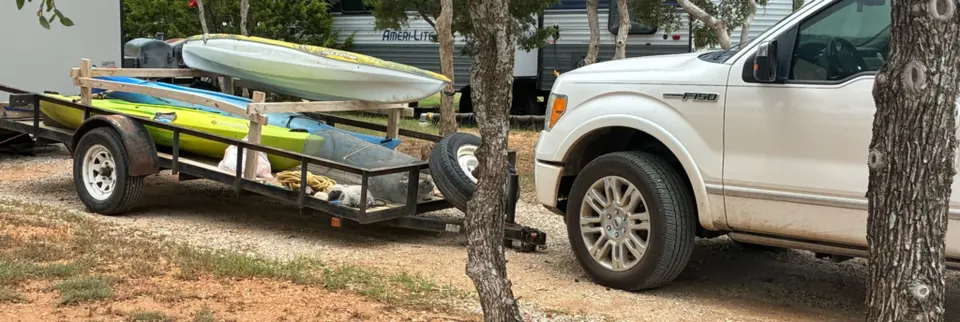
Down the hill past the sites is our private launch on the Leon River, the only private river access within 50 miles. Bring your own kayaks or canoes for Saturday morning.
Picture the Sunday of it: pancake griddle going, kids negotiating one more hour outside, grandma in the shade with coffee she didn't have to make. Nobody's rushing checkout, because the hard part happened 90 days ago in a spreadsheet.
One honest limit: we have one barndominium, and summer and holiday weekends go first. Memorial Day weekend 2026 filled 22 stays across the park without a dollar of advertising.
Send your headcount and three candidate weekends, or call (254) 629-1197, and we aim to reply to group quotes within 24 hours with dates and per-head math for your exact group. RV households can reserve their own sites at our online booking page.
Ninety days is the working minimum for a regular weekend, and six months is safer for a holiday. RVshare's holiday booking analysis puts the average lead time at about 64 days for July 4 and about 74 days for Labor Day, for single families. A group needs more runway than that, so the first step in how to plan a family reunion is locking the date and the beds.
One decider, not a committee. The organized person who actually wants it to happen appoints themselves, announces it, and hands every household exactly one job. Committees produce 200-message threads; deciders produce locked dates. If nobody volunteers by spring, the reunion probably isn't happening this year, and it is kinder to say so in March than in October.
For lodging in a shared format, plan on about $27 to $40 per person per night for 10 to 25 people. At our off-season weekend rates, a barndominium that sleeps 11 (see rates on the booking page) plus four RV sites from $40 is one lodging option; check the booking page for current rates. Keep food out of restaurants and collect money up front.
Two nights, Friday to Sunday. One night feels like a long dinner, and three nights starts costing vacation days and patience. Two nights buys five shared meals and one full unhurried day, which is enough time for the cousins to stop being polite with each other. Plan two anchor events on Saturday and leave the rest open.
Three locked decisions first: date, venue, and per-head budget. Then dated tasks: the announcement email by day 60, a booking deadline with teeth, one job per household by day 45, headcount and money by day 30, a one-page info sheet by day 14, and menus by day 7. That is how to plan a family reunion on one page, and every line needs one owner's name next to it.
Deadlines with consequences, stated kindly: the vote closes Sunday, and held sites are released on the 15th. People commit to specifics, never to sometime this summer. Expect a rush right before each deadline, and use a split-bill setup where late RSVPs book their own spot so one straggler never reprices anyone else. That rule is most of how to plan a family reunion people actually attend.