
Published | Updated
Every spring, the same text thread starts up. Three families, one shared idea: we should all go camping together this year. Then somebody tries to book it, and the plan dies in the group chat.
One park is full. Another has three open sites, but they sit on three different rows. A multi-family camping trip rarely fails at the campfire. It fails at the booking screen, months earlier, and nobody warns you about that part.
Groups that get it right do the same five things, and one of them is a phone call. You can do all of it this week, and the first step is not the one you think.
Quick answer: A multi-family camping trip works best when every family books its own RV site at one park, side by side, arranged by one person who calls the park directly. Booking engines show open sites, not which ones touch. At Inez Spring in Eastland, Texas, full-hookup RV sites start at $40 a night, so two nights start at about $80 per family, with the private kayak launch and walking trails to enjoy.
Camping with multiple families solves the problem every shared vacation house creates: one kitchen, one thermostat, and one couple stuck with the pullout couch. Splitting a house sounds cozy right up until the sleeping assignments go out.
On a multi-family camping trip, every family keeps its own rig. Own beds, own bathroom, own coffee timing, own bedtime rules. The kids roam as a pack all day, the adults meet at one site after dark, and then everybody retreats behind their own door. Nobody hears your toddler at 6 AM, and you don't hear their teenager at midnight.
When each family controls its own booking, its own food, and its own departure time, the trip stops depending on the one organized person who usually burns out by Saturday lunch. Each rig is its own kitchen, its own storage, and its own backup plan when the weather turns.
The national numbers back the format. The KOA camping report released in April 2026 found 35 percent of U.S. adults call camping the easiest form of travel with children, and 35 percent say camping is the most affordable travel option. Easy with kids and cheap per family is the whole pitch of group camping.
One honest caveat before the how-to. Somebody in your group doesn't want to sleep in a rig, and it's probably a grandparent. There's a fix for that, and it sleeps 11. More on it below.
Before you call anyone about a multi-family camping trip, know what you're asking for. "Next to each other" means three different things at three different parks, and the group that doesn't say which one it wants gets whichever is left.
For most groups of three or four families, side by side sites on one row are the target. That's the request a multi-family camping trip should be built around.
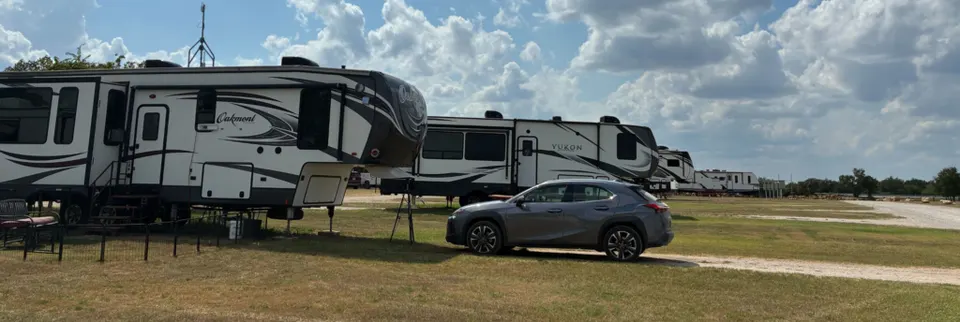
Most groups book like polite strangers. Each family reserves online, on its own night, with its own guesses, and everyone shows up to find they're camping a five-minute walk apart. Nothing sinks a multi-family camping trip faster, because being close was the whole point.
The One-Booker Method fixes the multi-family camping trip booking problem in five steps:
Step 3 decides whether you spend the weekend as neighbors or as acquaintances who wave. Here's each step in detail.
Headcount doesn't decide anything at an RV park. Rigs do. Before anyone argues about dates, collect three numbers from each family: rig length, rig type, and whether it runs 30 or 50 amp.
A 38-foot fifth wheel and a pop-up camper have different site options, and the first question any park worth calling will ask is how long your longest rig is. Write the numbers down once and the rest of the booking takes ten minutes.
Pick one booker. Not the most organized parent. The most responsive one. One person calls, one person holds the confirmations, and one person fields the can-my-brother-in-law-still-come question.
When three families call a park separately about the same weekend, sites get grabbed out of order and nobody sees the whole picture. One name on the group lets the park treat your trip as one job instead of three coincidences.
Here's the step that decides the trip. A booking engine can tell you three sites are open. It usually can't promise they touch. A person looking at the actual site map can.
Call and say the sentence out loud: we're three families, and we need side by side sites on one row. Then ask what the park can hold.
At Inez Spring, more than 70 full-hookup sites across 24 acres give a group room to ask for one row. Group quotes get answered within 24 hours, so ask us to hold specific site numbers instead of gambling on a map.
Book every site from the same arrival date, even if one family can only show up for night two. With full-hookup sites from $40 a night, holding the third pad one extra night costs less than that family's fast food on the drive out.
The layout is the thing you can't buy back once it's gone. Sort the money out among yourselves afterward. Parks care about the reservation, not your spreadsheet.
Adjacent means different things at different parks, as the layout list above shows. Ask for actual site numbers and a one-line email confirming them, and if a park can't name sites, ask what it will commit to.
You're not being difficult. You're making the single request that separates a multi-family camping trip from three bookings that happen to share a weekend.
One timing note. Give yourselves six to eight weeks for a regular weekend and more for a holiday one. A single family can book late and find a pad. A group that books late finds three pads in three places.
Sometimes the row you want is taken. Don't let that kill the trip. Work through these fallbacks in order, on the same phone call:
Here's what a multi-family camping trip looks like with a real rate card instead of adjectives. Our full-hookup RV sites start at $40 a night with 30 and 50 amp service. Tent sites start at about $31. The barndominium, a 4-bedroom, 4-bath house that sleeps 11, has rates on the booking page.
For three families staying two nights, using our starting rates as of October 2026 (holiday weekends and specific sites can run higher, so confirm when you call):
| Setup | Who sleeps where | Nightly total, from | Two nights, from | Per family, split three ways |
|---|---|---|---|---|
| 3 RV sites in a row | 3 rigs, everyone in their own beds | $120 | $240 | About $80 |
| 2 RV sites + 1 tent site | 2 rigs plus the tent crew | $110 | $220 | About $73 |
| 2 RV sites + the barndominium | 2 rigs plus up to 11 in the house | About $380 | About $760 | About $253 |
That $80 per family is the number to send. It covers your own pad, your own hookups, and the private kayak launch on the Leon River. The pool is closed until Memorial Day 2027. A multi-family camping trip is the rare group format where the money math stays boring: everyone pays for their own site, and nobody subsidizes anybody's master bedroom.
Compare that to whatever lake-house quote is sitting in your group text right now.
If your crew is closer to 20 or 30 people, you're not planning a weekend anymore. You're planning a reunion. Our per-head cost guide to family reunion venues in Texas is built for that size, and our comparison of family reunion resorts, ranches, and RV parks helps if the group is still arguing about format.
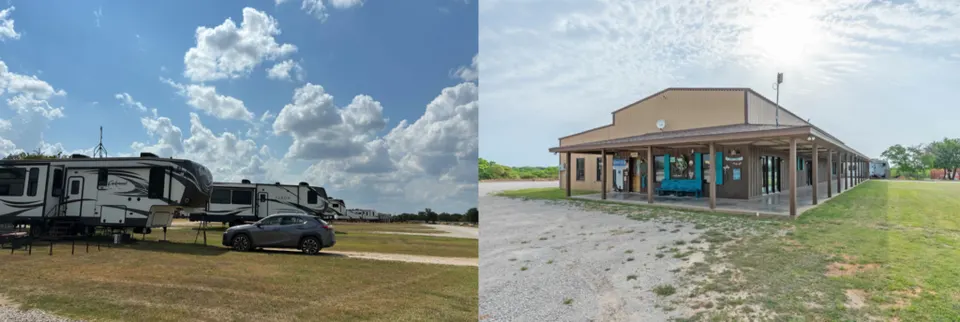
Every multi-family camping trip eventually hits the same snag: one household doesn't own a rig, or flat refuses the idea. Usually it's the grandparents. Sometimes it's the family that swears they'll rent one someday.
Mixed sleeping is the fix:
One Google review of the barndominium put it this way: "exceeded our expectations, the kids went nuts over the theater."
Groups already book this way here. Our booking records show the pattern: couples traveling together on paired sites, and extended families taking two or three pads in a row.
If your group runs small, say 10 to 25 people, steal the structure from our list of small family reunion ideas for 10 to 25 people. Most of those plans run fine from one row of RV sites, because camping with multiple families is really a small reunion with better sleep. For the full planning timeline, from the first group text to the head count, use our guide on how to plan a family reunion.
Booking gets the families onto one row. Three short agreements keep a multi-family camping trip friendly by Sunday. Settle these in the group chat before anyone packs.
Each family owns one shared meal and nothing else. Family one does Friday burgers, family two does Saturday breakfast, and family three does the Saturday potluck table. Every other meal is your own rig, your own timing. Nobody cooks for twelve twice, and nobody feels like the caterer.
| Each family brings its own | The group shares one |
|---|---|
| Beds, bedding, and bathroom kit | Long folding table for the potluck |
| Cooler, breakfast food, and coffee | A big water jug and paper goods for the potluck |
| Lawn chairs, one per person | A big pop-up canopy for shade |
| Kayaks or canoes, if you paddle (we don't rent them) | A first-aid kit and a flashlight bin |
| Pet gear for up to two pets per site | String lights and an extension cord |
Pick one rule for the river: no kid goes in without an adult from any family watching. Then pick a quiet hour that suits the youngest kid in the group, not the oldest teenager. Families with toddlers can turn in early behind their own door while the adults keep talking, which is the whole advantage of separate rigs.
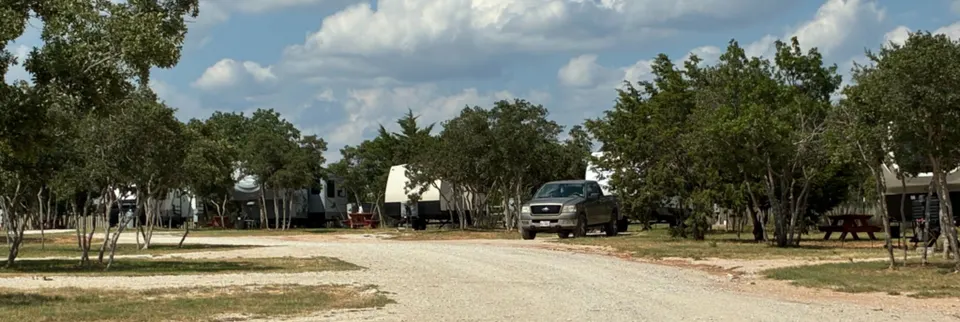
Here's one way to run a multi-family camping trip here, hour by hour. Swap the times to fit your crew.
Friday, 4 to 9 PM. Families roll in as work allows. We're at Exit 343 on I-20, about 2 hours west of Dallas and about 1 hour 35 minutes from Fort Worth, so the family that leaves after work arrives after dark, and that's fine. The gate code comes ahead of time and the site numbers are on the confirmation. First night is burgers, lawn chairs, and kids comparing bunks.
Saturday, 9 AM. Coffee happens at three separate tables, which is the entire point of separate rigs. By 10, kayaks are going in at our private launch, the only private access to the Leon River within 50 miles. Take turns. The river doesn't keep score.
Saturday, 2 PM. Walk the trails across 24 acres or take a 10-minute drive to Lake Leon.
Saturday, 7 PM. One long potluck table, the center of any multi-family camping trip. Every family cooks its specialty and nobody cooks a full meal. This is the two hours the whole trip was for, so nobody schedules anything after it.
Sunday, 10 AM. Slow coffee, slow pack-out, and somebody floats next year's dates before the trucks reach I-20. A group camping trip becomes a tradition on the drive home, not in the planning thread.
Call the park instead of booking online, and make the request explicit: number of rigs, each rig's length, and site numbers in a row. Booking engines show availability, not adjacency, while a staff member with a site map can hold specific pads. Get the site numbers confirmed by email, book every site from the same arrival date, and keep the group under one name so the park sees one job.
At Inez Spring, full-hookup RV sites start at $40 a night, so a two-night trip starts at about $80 per family when each family takes its own site. Tent sites start at about $31 a night if part of the group camps on the ground. Every family pays for its own spot, which keeps the money simple and the group chat friendly.
A cancellation removes one site, not the roof over the whole group. That's the structural advantage over one big rental house: the other families' bookings stand untouched. Ask about the cancellation window when you book, and if the empty pad matters to your layout, call the park and ask what can move. There's usually more flexibility on a phone call than on a checkout page.
Yes, and it is the easiest way to include everyone. Rig families book RV sites on one row, tent campers take tent sites from about $31 a night, and the no-rig household books the barndominium, which sleeps 11 across 4 bedrooms and 4 baths. Everyone shares the same river launch and trails. One phone call can hold the whole group at once.
On RV sites at Inez Spring, yes. The park is pet-friendly with a limit of two pets per site, so a three-family group can bring up to six dogs if every site carries two. For pets in the barndominium, ask when you book, especially if the grandparents travel with a dog. Plan shade and water for warm afternoons.
Late arrival is fine. Late check-in works with a gate code sent ahead of time, so the family leaving Dallas after work can pull in after dark and drive straight to their site. Set the expectation that arrival times will differ by hours, then let the early families have dinner going when the last headlights show up.
You already know the weekend you want. You've been describing it in the thread every spring: kids in a pack, adults around one table after dark, nobody doing dishes in someone else's kitchen. The gap between that idea and an actual campsite is one person willing to make one call. Every year it doesn't happen, the kids are one size bigger.
So do the small version now. Reply to the thread with two possible weekends and the words I'll book it. If you've hosted this crew for a backyard cookout, you can run a multi-family camping trip. It's the same job with a river attached.
A multi-family camping trip needs one thing from a park more than anything else: adjacency, held on purpose. That's what to ask for. More than 70 full-hookup sites with 30 and 50 amp service across 24 acres means a group of three or four rigs has room to ask for a single row, with water, sewer, and power at every pad.
Two pets per site. A gate code sent ahead for the late family. Group quotes answered within 24 hours, and 4.8 stars on 222 Google reviews as of October 2026.
Rather talk it through? Call the front desk at (254) 629-1197 and say the sentence: we're three families, and we need sites on one row.
Send the thread this post. Pick two weekends. Make the call. This is the year the multi-family camping trip leaves the group chat.
A barndominium that sleeps 11 plus RV and tent sites at one address in Eastland, Texas.