

Published | Updated
By Inez Spring Park Management.
It's 71 degrees at 3 PM in Eastland and you're in shirtsleeves at the picnic table. By 6 AM it's 27, the north wind is pushing your awning, and the water hose you left connected is a solid tube of ice. That's the winter months in Texas in one day. Mild, mostly, with a handful of nights that punish anyone who packed for Florida.
This guide answers the question people actually type, when is winter in Texas, with real National Weather Service numbers for the winter months in Texas in our part of the state. Then it gives you a freeze plan and a packing list sized for a first winter here.
Quick answer: The winter months in Texas are December, January and February on the weather calendar, but for RVers the cold season runs November through March. Near Eastland and Abilene, January averages a 58.8 degree high and a 33.7 degree low (NWS normals, 1991 to 2020). The first freeze lands around November 11 and the last around March 21. Expect bright, dry days and a few hard cold fronts.
Spending the winter months in Texas in your RV? Inez Spring Riverfront RV Park in Eastland is open year-round, one minute off I-20 at Exit 343, with full hookups and more than 70 sites. Winter monthly sites are $500 for a back-in or $650 for a pull-through, electric metered at 17 cents per kWh, $200 refundable deposit, month to month. Nightly from $40 to try a few nights first. Call or text (254) 629-1197, book online, or read the winter Texan stay page and the winter Texans playbook.
Ask three people when winter starts in Texas and you'll get three dates. All three are right. Only one helps you plan an RV season.
The third answer is the one your water lines care about. So for an RVer, the winter months in Texas are November through March. October is the arrival month. April is the drive home.
Texas is also big enough that "winter in Texas" is several winters. The Panhandle gets real snow. The Rio Grande Valley barely gets a frost. We sit in between, on the I-20 corridor about 2 hours west of Dallas and about 50 minutes east of Abilene, and that middle latitude is what the rest of this guide describes.
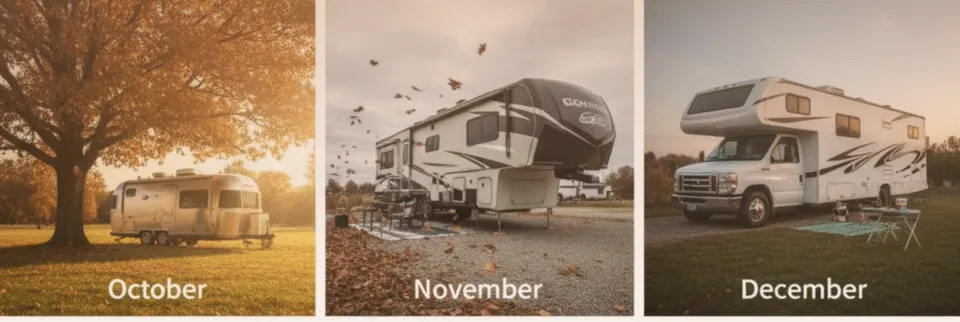
These are the official 1991 to 2020 normals for the winter months in Texas at Abilene, the closest National Weather Service station with a long record. Eastland, about 50 minutes east, runs close to them.
| Month | Normal high (°F) | Normal low (°F) | What it means in an RV |
|---|---|---|---|
| October | 79.3 | 54.7 | Arrival month. A/C some afternoons, no freeze risk most years. |
| November | 67.8 | 43.3 | First freeze around Nov 11. Get the skirting and heated hose on. |
| December | 59.4 | 35.2 | Short days, frequent frost. Heat runs every night. |
| January | 58.8 | 33.7 | Coldest month. Most hard freezes and any snow land here or in February. |
| February | 62.8 | 37.4 | Still cold at night. The 2021 storm hit in mid February. |
| March | 70.9 | 45.3 | Last freeze around Mar 21. Wind and the first spring storms. |
Highs near 79 and lows near 55. This is the easiest month of the season to set up in, and the smartest one. Level the rig, test the furnace on a cool morning, and find out now whether a fuse or a thermocouple is missing. You don't want to learn that on the first 30 degree night.
Highs drop to the upper 60s, lows into the low 40s, and the first freeze shows up around the second week. Cold fronts start arriving with a north wind you can hear coming. This is the month to put on skirting or foam board and swap to a heated hose.
A normal December day tops out around 59 and drops to 35 overnight. Frost on the windshield is routine. Solar gain is at its lowest, so your heat runs longer, and that shows up on a metered electric bill. Plan for it now rather than in January.
January is the floor: about 59 for a high and 34 for a low. Most hard freezes happen in January or February, and so does most of the snow, when it comes at all. A typical cold snap runs a night or two, then the afternoon is back in the 60s.
Highs climb toward 63 and lows sit around 37. The days are longer and the sun feels it. But February is also when the worst storm in recent memory hit, so don't strip the freeze kit early.
Highs near 71, lows near 45, and a last freeze around March 21. March brings gusty days and the start of thunderstorm season. Bring the awning in when you leave the site, and keep the heated hose on until the forecast has stayed above freezing for a week.
Up north, winter is a season. Here it's a series of events. The averages in the table are true, but nobody lives an average day. You live a run of 65 degree afternoons, then a front drops through and the next morning is 25 with a wind chill in the teens.
That swing is the whole story of Texas winter weather for RVers. It isn't the depth of the cold that breaks things. It's the speed. A front can take 40 degrees off the thermometer between lunch and breakfast, and the rig that was fine at noon has an exposed low point drain by midnight.
Snow is the smaller worry during the winter months in Texas. The NWS lists average seasonal snowfall at Abilene at 4.9 inches, and most of it comes in one or two light events that melt fast. Ice is the bigger one. A glaze on I-20 shuts down travel faster than snow does, so on a freeze night the right move is to stay parked.
February 2021 is the outlier that set the bar. According to the NWS San Angelo February 2021 summary, Abilene hit minus 4 degrees on February 16. It took 9.8 inches of snow on February 14, the most ever recorded there in one day. And it stayed at or below freezing for 252 hours straight, more than ten days.
That kind of storm is rare. But it's the reason for one simple rule: pack for the normal winter, and keep a plan for the bad week. The plan is below.
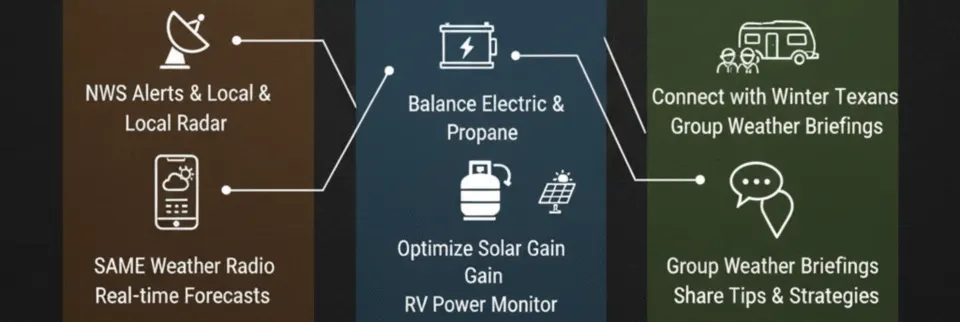
Most packing lists hand you gear and stop. Gear without a trigger point is how hoses freeze with the heat tape sitting in a bay. So here's the routine we suggest, keyed to the forecast low. Check the overnight low every afternoon during the winter months in Texas, then climb the ladder only as far as the number tells you to.
One more rung matters more than all four, and most packing lists skip it. We'll get to it at the end of the packing list.
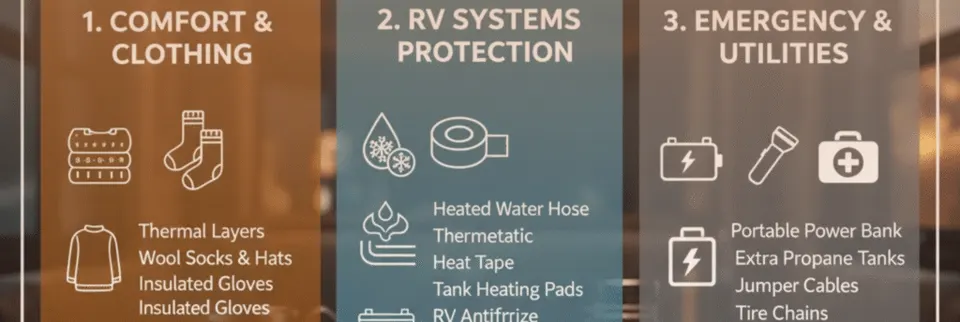
This RV packing list is built for a winter of bright 60 degree afternoons and a short run of freezing nights, not for Minnesota. If an item isn't on here, you probably don't need it for a Texas winter.
Now the rung we promised. It isn't gear.
It's a written list of every water connection on your rig: inlet, pump, low point drains, outside shower, the ice maker line if you have one. Walk it once in daylight in October. The line that freezes is almost always the one the owner forgot was there.
They pack for the coldest place in the country, not for the winter months in Texas. You end up with a closet of gear you never use, and still no plan for the one night that matters. The other mistake is cost. A winter rig running electric heat on a metered site pays for every hour of it, and nobody mentions that until the first bill.
Here's the math at our posted rate of 17 cents per kWh. One 1,500 watt heater running 12 hours a day uses about 540 kWh a month. Two heaters double it.
That's an estimate from the rate, not a bill, but it's why propane and electric heat should split the job. Our guide to winter Texan monthly rates and electric costs runs the full comparison. If you're still choosing the rig itself, our guide to the best all-season RV for a Texas winter covers insulation, tank heaters and the features that matter here.
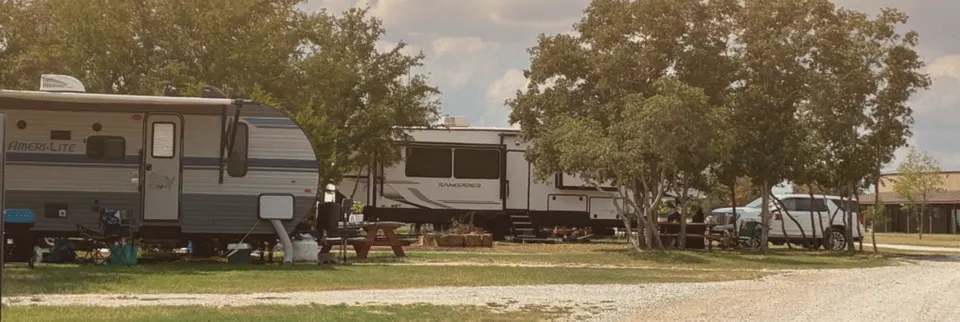
If you've read this far, you already know what you want from a Texas winter: mild afternoons, a few cold nights you're ready for, and no surprises on the bill. That's a short list. It also rules out a lot of places.
The traditional move is to drive to the Rio Grande Valley. It's warmer, no argument. It's also another long day or two of driving each way from most of the Midwest. Our snowbird RV route guide through Texas lays out the miles and days from Kansas City, Omaha and Chicago, so you can decide whether the extra drive buys enough sun.
On the I-20 corridor, the winter months in Texas look like the table above: 59 degree Januarys, bright days, a real freeze plan, and about 2 hours to Dallas when family flies in. Abilene's hospitals and big stores are about 50 minutes west. Lake Leon is about 10 minutes away for a calm-day cast; our Lake Leon fishing guide covers ramps and seasons. For other stops along the interstate, see the I-20 RV parks guide for Texas.
We're a family-run park on 24 acres along the Leon River, with more than 70 full-hookup sites on 30 and 50 amp service. Here's what matters for the winter months in Texas, and what doesn't:
Guests rate us 4.8 stars on 222 Google reviews as of October 2026. One guest review sums up the winter case, verbatim: "quiet nights, friendly community, convenient I-20 access."
Picture the middle of January. The front came through Tuesday, your heated hose did its job, and by Thursday afternoon you're in a folding chair by the river with a coffee, in a light jacket, while the forecast back home says single digits. That's the trade you're making.
The full season plan, from how winter Texans spend their weeks here to how to pick a park, is in our winter Texans playbook for the I-20 corridor, and the unwritten rules of a shared winter row are in our winter Texan etiquette guide.
A winter site works here because the rate is plain and the place is built for the weather you just read about. Full hookups on 30 or 50 amp hold a heat load. Metered power means you pay for what you use, at a rate you know up front. And month to month terms mean a family emergency back home doesn't strand a season's rent.
Prefer to try a few nights first? Nightly full-hookup sites start from 40 USD, with cliffside and pull-through sites at 45 USD, as listed on our rates page. Every site type is on the RV sites page, and the full price list is in our Inez Spring RV park rates guide.
See monthly RV sites from 500 USD a month, check nightly dates for a scouting stay on our online booking page, or call or text (254) 629-1197 with your rig length and your months.
Send your arrival month and rig length. The office replies the same day with what is open and the monthly total, electric billed on the meter.
On the calendar, winter in Texas runs from the December solstice, December 21, to the March equinox around March 20. Weather services use December, January and February. For RVers the useful answer is wider: the cold season runs from the first freeze, around November 11 near Abilene, to the last freeze, around March 21, so the practical winter months in Texas are November through March.
January is the coldest month across most of Texas. Near Eastland and Abilene the 1991 to 2020 normal is a high of 58.8 degrees and a low of 33.7 degrees, according to the National Weather Service in San Angelo. December runs almost as cold, with a 59.4 degree high and a 35.2 degree low, and February warms only slightly.
Sometimes, but not much. The National Weather Service lists average seasonal snowfall at Abilene, the nearest long-record station, at 4.9 inches. Most winters bring one or two light events that melt within a day or two. The exception is a storm like February 2021, when Abilene took 9.8 inches in one day and stayed at or below freezing for 252 straight hours.
Not the full blow-out-the-lines winterizing you would do up north, because you are living in the rig. You do need freeze protection: a heated or insulated water hose, a tested furnace, foam covers for exposed valves, and a plan for the handful of nights that drop well below freezing. The Freeze Ladder in this guide tells you what to do at 40, 32 and 25 degrees.
Pack for 60 degree afternoons and 30 degree nights in the same week. The core list is a heated water hose, skirting or foam board for the underside, vent cushions, a small dehumidifier, one 1,500 watt space heater, layers rather than a parka, and a weather radio. Add a sun hat. Most winter days in this part of Texas are bright and dry.
At Inez Spring, monthly sites run 500 USD for a back-in or 650 USD for a 100-foot pull-through, plus metered electric at 17 cents per kWh, with a 200 USD refundable deposit and month to month terms. There is no winter surcharge. One 1,500 watt heater running 12 hours a day adds about 92 USD a month, an estimate based on that rate.
Inez Spring sits at Exit 343 in Eastland, about 1 hour 35 minutes west of Fort Worth. Guides for RVers wintering in Texas.