

Published | Updated
By Inez Spring Park Management. Our family has owned this 24-acre RV park on the Leon River since 2024.
Picture the night before a hard front. The forecast says 19 degrees by sunrise, the wind is already turning north, and you're standing outside with a flashlight, staring at your water hose. If you've ever woken up to a frozen hose and a dry faucet, you already know how that morning goes.
The question underneath is always the same: is this an all season RV, or just an RV with a sticker that says so? The answer decides whether a January cold snap is a cozy night in or a 2 AM search for a heat gun.
This guide skips the brochure roundup. It covers what the four season label really means, how cold a Texas winter actually gets by region, the seven features that decide whether a rig holds up, and a retrofit list for the rig you already own. There's also one feature most buyers check last that should be first. It's number one on the list below.
Quick answer: An all season RV is a rig built or upgraded to stay livable through freezing nights: an enclosed, heated underbelly, tank heaters, dual-pane windows, a ducted furnace sized for the floor plan, and insulation the maker will put a number on. There's no industry standard for the label. For a Texas winter along I-20, with January lows near 33 degrees and a few hard freezes, a well-sealed rig plus a heated hose, skirting and a 50-amp site covers most nights.
Start with the uncomfortable fact. "Four season" and "all season" are marketing words, not certifications. RV Travel's technical columnist put it plainly in a 2023 answer to a reader: "there is no industry standard for what a Four Season package or option contains."
The same column notes that most such packages add a water heater bypass valve, dual-pane windows and a higher-BTU furnace, and that most do not include heated holding tanks. Let's RV lands in the same place: there is no universally accepted standard, so you judge the features, not the badge.
So when we say all season RV on this page, we mean a rig that can keep water flowing and people warm through a freezing night without heroics. Some leave the factory that way. Plenty get there with a weekend of upgrades.
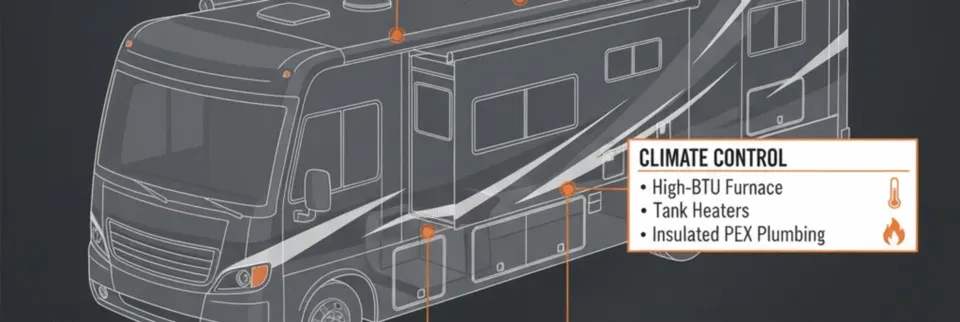
Most cold-weather RV advice is written for Colorado ski towns. Texas is a different problem. The table below uses January averages from NOAA's 1991 to 2020 climate normals, as compiled by Extreme Weather Watch.
| Where winter Texans park | Reference city | Avg January high | Avg January low | What your rig needs |
|---|---|---|---|---|
| Rio Grande Valley | McAllen | 72.1 F | 51.3 F | Basic sealing; freezes are rare |
| North Texas | Dallas | 57.4 F | 37.9 F | Heated hose, serviced furnace |
| I-20 west of Fort Worth (Eastland) | Abilene | 57.6 F | 33.4 F | Heated hose, skirting, freeze-night plan |
| Panhandle | Amarillo | 51.5 F | 24.2 F | A true cold-weather package |
Averages hide the tail, though. Abilene's all-time record low is minus 9 degrees, set on January 4, 1947, according to the National Weather Service in San Angelo. And anyone who lived through the February 2021 storm knows Texas can freeze hard statewide.
The practical read for anyone shopping an all season RV for Texas: along I-20 you don't need an arctic package. You need freeze protection that works for two or three nights at a time, a few times a winter. That's a narrower, cheaper problem, and it changes which features are worth paying for.
We call this the Texas Seven. It's the order we'd check a rig in if a friend asked us to look at one before a winter on I-20, from most important to least.
Here's the same list as a quick buying screen, weighted for a Texas winter rather than a Montana one.
| Feature | What to check | For a Texas winter |
|---|---|---|
| Enclosed, heated underbelly | Crawl under it; look for ducting into the belly | Must have, or retrofit |
| Fresh tank heater | Spec sheet, thermostat control | Must have |
| Interior water lines | PEX routing, water heater bypass | Must have |
| Ducted furnace | BTU rating and duct count by room | Must have |
| Dual-pane windows | Spec sheet or a look at the frame | Strong nice-to-have |
| Published R-values | Walls, roof, floor in numbers | Nice-to-have |
| 50-amp service | Shore cord and panel | Strong nice-to-have |
If you want names to start from, here are three trailers whose cold-weather specs are published, as listed by Let's RV. We haven't tested them; this is a spec read, not an endorsement. Model years change, so confirm the current spec sheet before you buy.
| Model (as listed) | Cold-weather specs published | Texas Seven read |
|---|---|---|
| Grand Design Reflection 296RDTS (fifth wheel) | 30,000 BTU furnace, heated and enclosed underbelly, 12-volt tank heater, heated dump valves, R-40 roof, R-30 floor | Covers features 1, 2, 4 and 6 on paper; check windows and amp service |
| Northwood Arctic Fox 25Y (travel trailer) | Heated holding tanks and plumbing, sealed underbelly, thermal-pane windows, R-18 ceiling, ducted furnace | Strong on tanks, windows and insulation; ask whether the belly gets furnace heat |
| Forest River Rockwood Ultra Lite 2608BS (travel trailer) | 35,000 BTU furnace, enclosed underbelly, heated holding tanks, R-14 ceiling, R-12 floor, R-7 sidewall | Lighter build with a big furnace; skirting helps on freeze nights |
Any of the three, or a used rig that passes the inspection further down, can be the best all season RV for an I-20 winter. The badge matters less than the spec sheet.
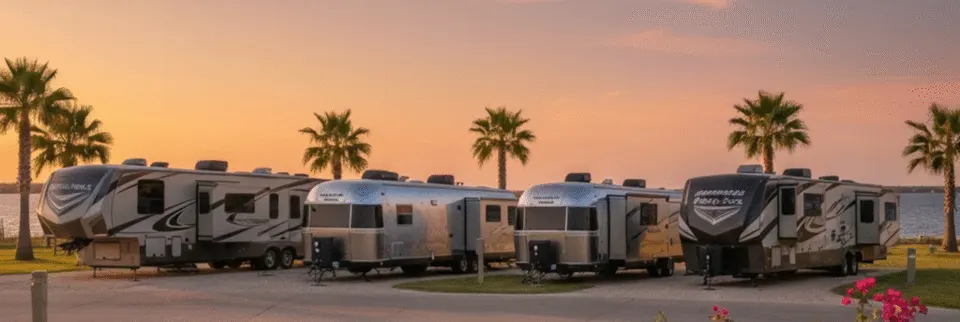
No single body style wins every winter, and cold weather RVs come in every shape. Each one trades something, and the right all season RV for you depends on how long you'll stay and how often you'll move.
The best travel trailers for winter are the ones whose spec sheets list the Texas Seven in writing. Lighter trailers often save weight in the underbelly and the windows, so read closely. A mid-size trailer with an enclosed belly and a ducted furnace makes a very capable all season RV for I-20 winters.
Fifth wheels tend to carry more of the cold-weather features as standard, plus more storage for a season's worth of gear. The trade is size: make sure the park you pick has the pull-through length you need before you commit to a long rig.
A motorhome can be a strong all season RV because it heats a single envelope, and many carry basement storage with heated bays. Watch the engine side too: batteries and fuel lines don't love a hard freeze, and the coach heat doesn't reach them.
Bunkhouse floor plans are where heat distribution gets tested. Kids' bunks often sit on an outside wall at the far end of the duct run. Ask whether the bunk room has its own furnace duct, check the slide seals, and look at window size. Big windows are great in July and cold in January.
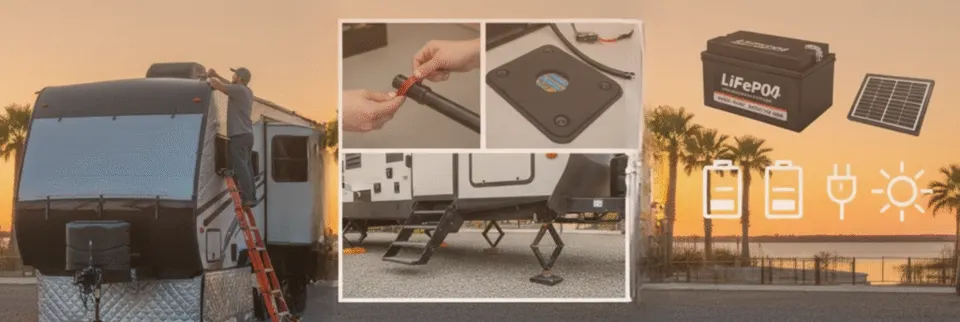
Most winter Texans don't buy a new rig for the season. They turn the one they have into an all season RV, one upgrade at a time. For four season camping along I-20, this list, in this order, covers most of the gap:
Our Texas winter weather packing list for RVers turns this into a printable checklist with the smaller items, from extra hose washers to a tank-sensor flashlight.
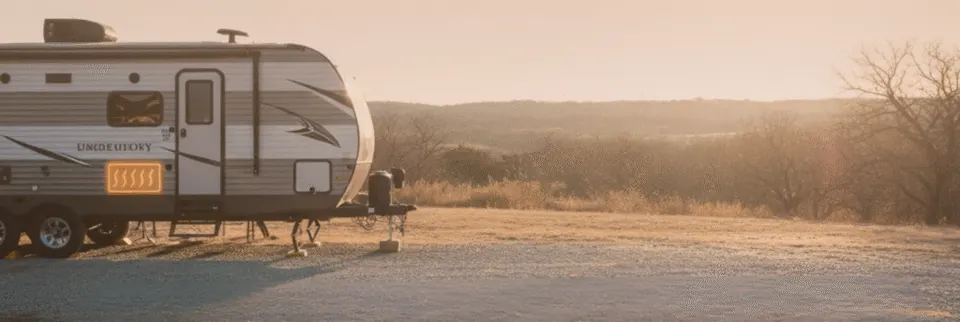
When the forecast shows a hard freeze, here's the sequence. Do it in daylight, before the wind shifts.
None of this is exotic. It's the routine that turns a cold snap into a quiet night, and our guide to winter Texan etiquette and community in Eastland covers the neighbor side of freeze nights, from shared pedestals to checking on the rig next door.
Plenty of winter Texans buy a used rig before their first season. If that's you, remember that a spec sheet only tells you what the rig had when it was new. Here's the quick inspection we'd run on a lot or in a seller's driveway.
Fifteen minutes here saves a January of surprises. A rig that passes is a fair all season RV for Texas even if it never wore the badge.
Here's the part rig guides leave out. An all season RV on a 30-amp pedestal with an exposed spigot is still a three-season experience. The site does half the work.
When you screen a winter park for your all season RV, ask four questions.
Does it have 50-amp sites? Are the water risers protected, and what happened to them in the last hard freeze? Is electric metered, and at what rate per kWh? And who answers the phone at 9 PM when a front comes through?
Skip those questions and the cost shows up in January, not in the brochure: a frozen line, a breaker that trips every morning, a power bill nobody explained. One guest review of our park, verbatim: "quiet nights, friendly community, convenient I-20 access." Quiet nights in January start with a site that keeps your water flowing. Our winter Texans playbook on where to spend winter in Texas walks through how to screen a park in one phone call, and our winter Texan monthly rates guide shows what the metered-electric math looks like over a month.
Comparing parks? The I-20 RV parks guide for Texas covers the corridor from Fort Worth to Abilene, and our RV parks in Eastland, TX comparison lines up the local choices.
Picture a Tuesday in January at Exit 343. The front came through overnight on a north wind. It's 24 degrees at sunrise, and inside it's 68. The heated hose did its job, the belly stayed warm, and the coffee maker ran without tripping anything.
By noon it's 50 and climbing. By Thursday it's back near 60, and you're walking the river trail in a light jacket while the rig sits there, unbothered. That's what a ready all season RV buys you in Texas: winter on your terms, with the hard nights reduced to a routine.
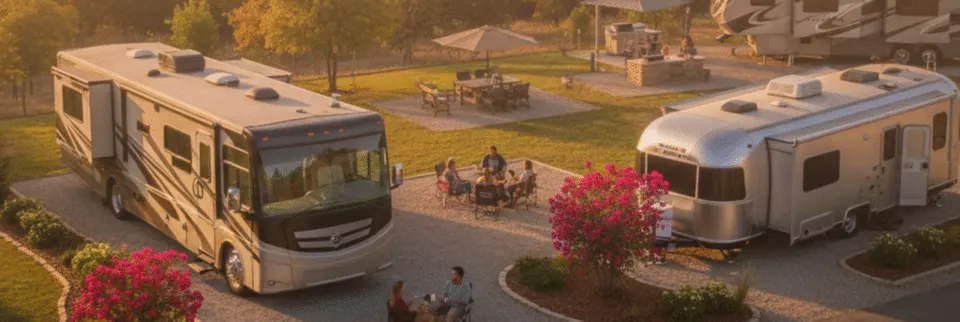
Inez Spring Riverfront RV Park sits at Exit 343 on I-20 in Eastland, about 1 hour 35 minutes west of Fort Worth, about 2 hours west of Dallas and about 50 minutes east of Abilene. We have more than 70 full-hookup sites with 30 and 50 amp service on 24 acres along the Leon River, and 4.8 stars on 222 Google reviews as of October 2026.
See monthly winter sites from $500 a month: $500 for a back-in or $650 for a pull-through, plus metered electric, with a $200 refundable deposit and month-to-month terms. Prefer to test the rig for a few nights first? Book a nightly site online from $40, or call (254) 629-1197.
An all season RV is a camper or motorhome built, or upgraded, to stay livable through freezing nights. There is no industry standard for the label, so judge the features instead: an enclosed and heated underbelly, tank heaters, dual-pane windows, a ducted furnace sized for the floor plan, and insulation the maker will put a number on. Two rigs with the same badge can handle cold very differently.
Usually not along I-20 or farther south. Abilene, the closest NOAA station to Eastland, averages a January low near 33 degrees, with a few hard freezes each winter rather than weeks of deep cold. A well-sealed three-season rig with a heated hose, skirting, a serviced furnace and a 50-amp site handles most of it. The Panhandle is a different story.
Four season camping means using your RV or tent in every season, winter included, rather than parking it from November to March. For RVers it mostly comes down to keeping water flowing and the living space warm through freezing nights. In Texas that usually means preparing for short cold fronts, a few hard freezes and windy days, not months of snow.
Most travel trailers, fifth wheels and motorhomes have one, but some small teardrops, pop-ups and older units skip it or carry a very small tank, so check the spec sheet. In winter the fresh tank matters more than people expect: on a hard-freeze night you can disconnect the hose and run on the tank, as long as the tank itself is inside a heated or enclosed space.
The best travel trailers for winter are the ones whose spec sheets show the cold-weather basics in writing: a heated and enclosed underbelly, tank heaters, thermal-pane windows, a ducted furnace in the 30,000 to 35,000 BTU range for mid-size floor plans, and published insulation values. Read the spec sheet, not the decal, and crawl under the trailer before you buy.
It can be, with discipline. A 30-amp service carries one electric space heater plus light loads, but adding a microwave, coffee maker or a second heater can trip the breaker on a cold night. A 50-amp site gives an all season RV room to run electric heat and still cook. Either way, keep propane topped off so the furnace can carry the coldest hours.
Monthly winter sites on the Leon River at Exit 343 on I-20, October to March.