Published | Updated
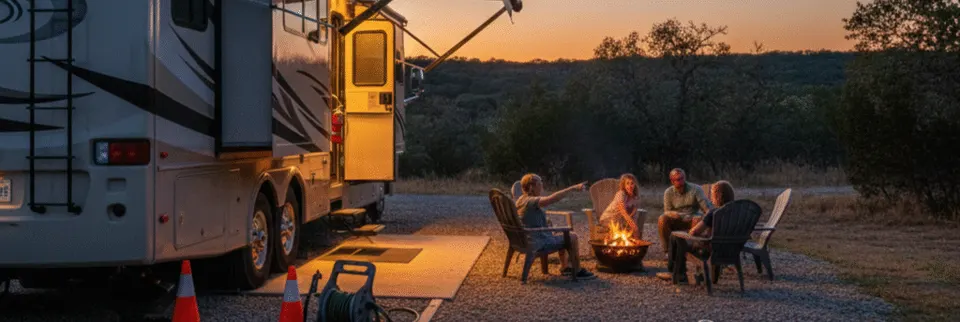
It's 4 PM on a Saturday in May. The sky to the west has gone a color you don't see in the city. Your awning is out, the kids are down at the river, and your phone just buzzed with a warning you didn't read.
That is how most bad camping days start. Not with bad luck, but with three small things nobody planned for at the same time. RV camping safety in Texas is mostly about seeing those things coming: the heat, the storm, the water and the drive.
We run an RV park on the Leon River off I-20, and this is the safety talk we would give you at the front desk if we had ten minutes. One of the four risks below catches more careful campers off guard than the other three, and it is not the one people expect. It's the last one on the list.
Quick answer: RV camping safety in Texas comes down to four checks. Weather: watch for heat and summer storms, keep a weather alert on, and pull the awning in early. Water: life jackets for kids, no swimming alone, and stay off rivers after heavy rain. Wildlife: watch for snakes, fire ants and ticks, and store food. Wheels: drive in daylight, watch for deer at dawn and dusk, and check tires in the heat.
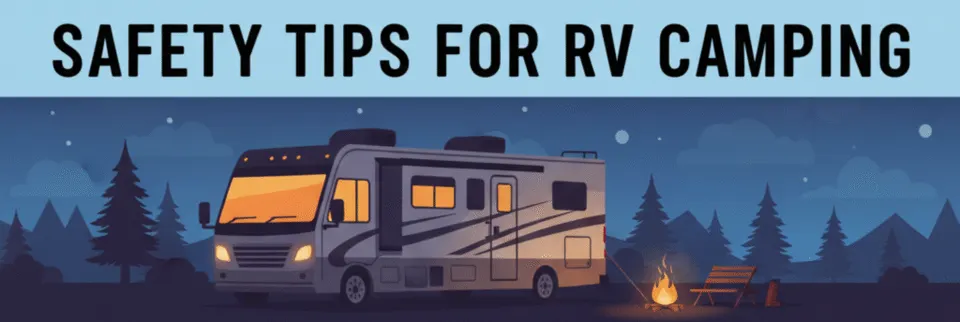
Most camping safety tips, and most RV camping safety mistakes, fit into four buckets: Weather, Water, Wildlife and Wheels. If you can answer one question for each before the trip, you have a plan. Use the table below as a quick RV safety checklist.
| Check | Peak season in Texas | Main risk | Your first move |
|---|---|---|---|
| Weather: heat | June to September | Heat exhaustion, heat stroke, pets in a hot rig | Plan the 2 PM to 5 PM hours around shade or water |
| Weather: storms | Spring and early summer, plus fall fronts | Lightning, hail, wind, flash floods | Weather alerts on, awning in early, know where to shelter |
| Water | May to September, and after any heavy rain | Drowning, fast water after storms | Life jackets for kids, never swim alone |
| Wildlife | Warm months | Snake bites, fire ant stings, ticks | Shoes on, flashlight at night, food stored |
| Wheels | All year, worst at dawn and dusk | Deer strikes, crosswinds, blowouts, fatigue | Arrive before dark, check tire pressure cold |
The rest of this guide takes each bucket in turn, then gives you a five-minute daily routine you can actually stick to.
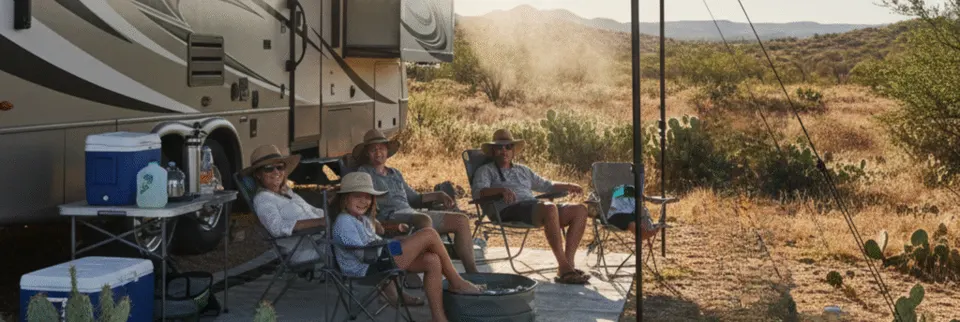
Summer afternoons in our part of Texas often sit in the high 90s and can top 100. Heat doesn't announce itself like a storm does. It wears people down over a long afternoon, and kids, older guests and dogs feel it first.
Heat exhaustion looks like heavy sweating, cool clammy skin, weakness, nausea and a headache. Move the person to shade or AC, loosen clothing, sip water and cool them with wet cloths. If it gets worse or lasts more than an hour, get medical help.
Heat stroke is an emergency. Watch for hot skin, confusion, a fast strong pulse, or someone who passes out. Call 911, then cool them fast while you wait. The National Weather Service heat illness guide lays out both side by side.
A closed RV in the sun heats up fast if the power drops or a breaker trips. Never count on the AC alone when you leave a dog inside. Use a temperature monitor that alerts your phone, and walk dogs early and late, when the ground is cooler on their paws.
At Inez Spring, walking trails cross 24 acres, so plan walks for the cooler hours.
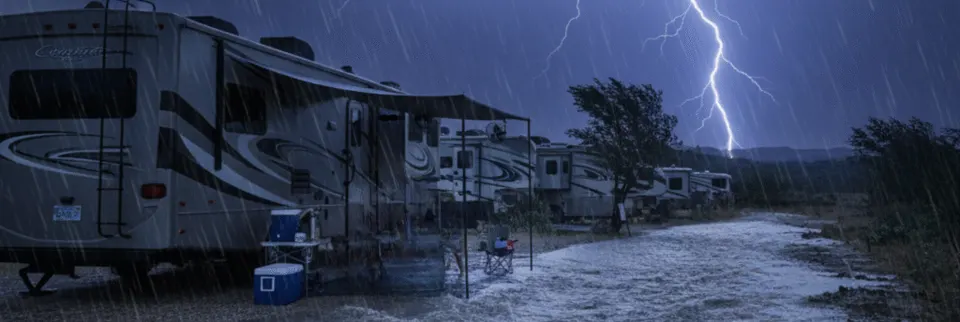
Texas storms build fast in spring and early summer, and fall cold fronts can bring their own lines of storms. The danger for RV campers is not only the lightning. It is wind on an extended awning, hail on a skylight, and water on a road you need to leave by.
Is an RV a safe place in lightning? Not in the same way a building is. The National Weather Service lightning safety page points to enclosed buildings and hard-topped metal vehicles as the safer places. Tents, picnic shelters and open water are not.
Low-water crossings on Texas county roads can look harmless after a storm. They are not. Per the National Weather Service, 6 inches of fast-moving water can knock over an adult, 12 inches can carry away most cars, and 2 feet can carry away SUVs and trucks.
A loaded truck towing a trailer is not an exception. If water is over the road, turn around and find another way. If a flash flood warning covers your campsite area, pack up early and leave while the roads are dry, not after.
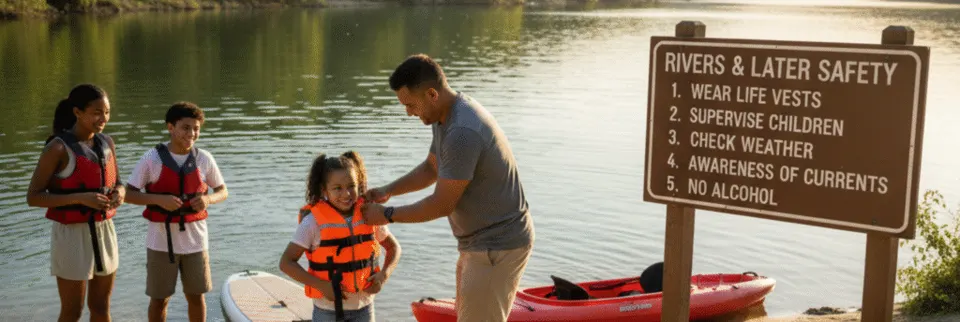
Water is the best part of a Texas camping trip and the part that deserves the most respect. Good RV camping safety near water is simple and boring, which is exactly why people skip it.
Texas requires children under 13 to wear a Coast Guard approved life jacket on recreational boats under 26 feet while underway, and underway includes drifting (Texas Parks and Wildlife life jacket rules). We treat a kayak the same way, and we'd go further: if a kid is near moving water, the jacket is on. Make sure it fits snugly; a jacket that rides up over the chin is the wrong size.
At Inez Spring, guests bring their own kayaks and put in at a private launch on the Leon River inside the park, and Lake Leon is about 10 minutes away. If you are not sure about river conditions after a storm, call the front desk before you put a boat in. The Leon River kayak launch page has the details.
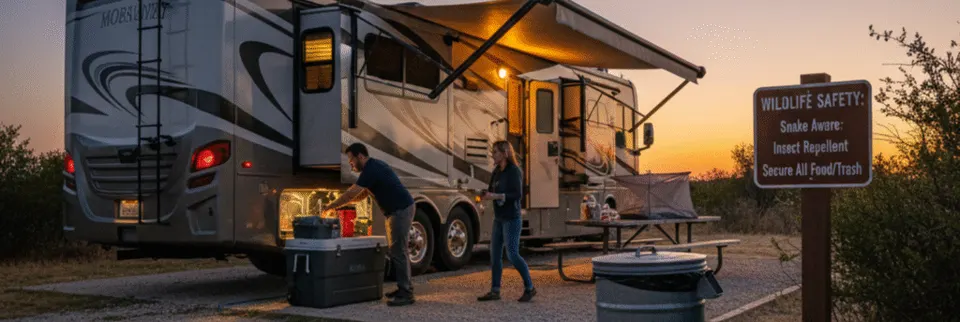
Texas has venomous snakes, and most bites happen when someone steps or reaches where they can't see. Wear closed shoes on trails and in tall grass, carry a flashlight after dark, and don't reach under rocks, logs or the RV without looking.
If someone is bitten, here is what the CDC venomous snake guidance says to do:
And what not to do: no cutting, no sucking out venom, no tourniquet, no ice, and no trying to catch or kill the snake. That rules out the old snakebite suction kit too. If your first aid box still has one, take it out.
Raccoons are the usual night visitors at Texas campsites. Keep food and coolers inside the rig or a vehicle overnight, bag trash tightly and use the park bins. A clean site keeps the visitors away from your dog, too.
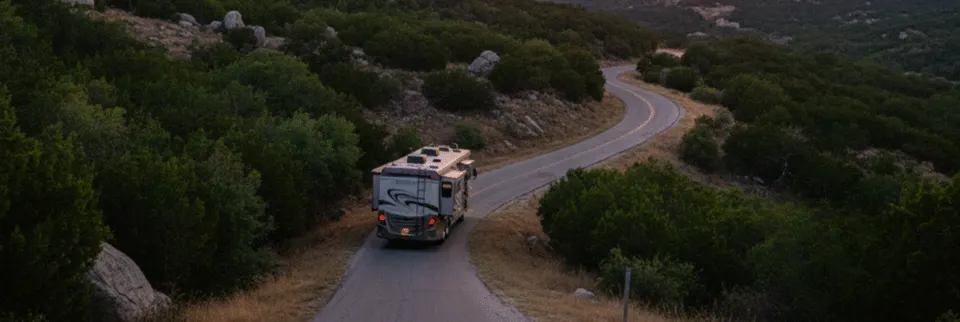
Here is the one we promised at the top. Most RV camping safety lists talk about the campsite. The riskiest part of the weekend is often the last hour of the drive in, when people are tired, it is getting dark, and the deer come out.
Deer cross rural Texas roads most at dawn and dusk. Slow down on two-lane roads at those hours, use high beams when no one is coming, and watch the shoulders. If one deer crosses, expect a second. Braking hard in a straight line is safer than swerving a heavy rig.
Plan to arrive before sunset when you can. If you can't, call ahead: at our park, late arrivals get a gate code and site directions before they reach Exit 343, so nobody is hunting for a site in the dark. The I-20 RV park map shows the stretch between Fort Worth and Abilene.
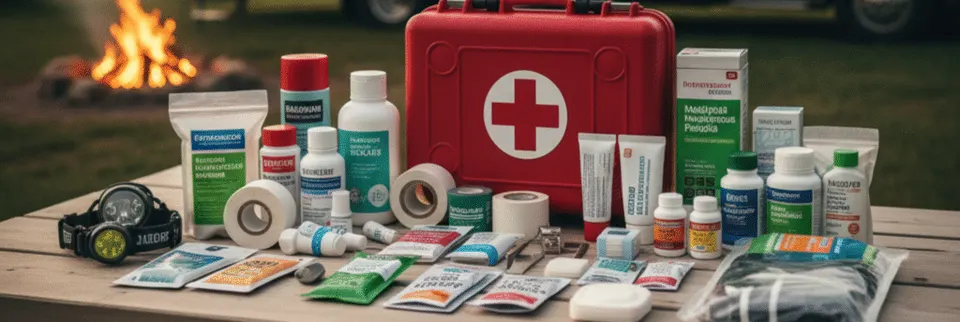
Your first aid kit should match what actually happens on a camping trip: cuts, splinters, stings, sunburn, a twisted ankle, an upset stomach. The full gear list lives in our RV camping checklist for Texas, so here we cover the RV camping safety plan for emergencies.
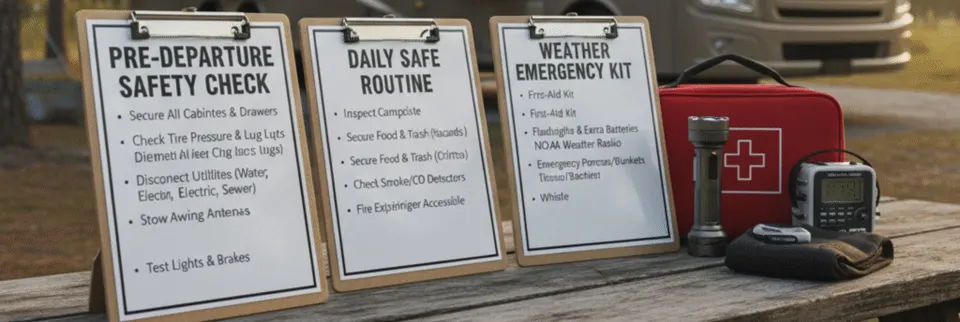
RV camping safety plans fail when they are long. This RV safety checklist takes five minutes with your morning coffee, and you can screenshot it for the fridge.
Earlier versions of this page called it a Central Texas safety guide and talked about Hill Country roads. That was wrong for where we are. Eastland sits on I-20 about 1 hour 35 minutes west of Fort Worth and about 50 minutes east of Abilene, in ranch country between Dallas and West Texas.
The RV camping safety basics above hold across most of the state: heat, spring storms, rivers that rise after rain, snakes and fire ants are as real in Eastland County as in the Hill Country. For trip ideas statewide, see our guide to RV camping in Texas, from the Hill Country to the I-20 corridor, and the free and cheap RV camping guide if you are weighing a dry site.
If you've ever ridden out a storm at a dry site with the generator low and no one to call, you already know the difference a staffed park makes. Most of the RV camping safety risk in this guide comes from being far from help, low on power, or unsure what the water is doing.
That is the kind of park we run. At Inez Spring Riverfront RV Park, your rig sits on a full-hookup site with steady 30 or 50 amp power, so the AC keeps running through a heat wave. There is a front desk you can call about river conditions, late arrival or where to go in a storm. And the I-20 exit is right there when you need to leave.
Picture the same Saturday from the top of this page, run the other way. You saw the alert at noon. The awning went in at 3, the kids came up from the river at the first thunder, and by 4 PM you are inside with the AC on, watching the storm cross the field. By 6 the sky clears and the evening is yours.
There is one more thing that doesn't show up on any safety list: how a park feels at night. One reviewer put it this way: "quiet nights, friendly community, convenient I-20 access." Guests rate the park 4.8 stars across 222 Google reviews (October 2026).
RV sites start from 40 USD a night and tent sites from 30 USD. Check open dates and book your full-hookup site from 40 USD a night.
Heat, storms, water and the drive. Summer heat is the most common problem, especially for kids, older guests and pets left in a rig. Spring storms bring lightning, hail and flash floods, rivers change fast after rain, and on the road deer at dusk, crosswinds and hot tires cause most trouble. Good RV camping safety in Texas means a plan for each of the four.
Move early, not late. If a flash flood warning covers your area, pack up and drive to higher ground while roads are still clear. Never drive into moving water: the National Weather Service says 12 inches of rushing water can carry away most cars, and 2 feet can carry away SUVs and trucks. Turn around, find another route, and call the park office for directions out.
An RV is not the same as a lightning-safe building. The National Weather Service considers enclosed buildings with plumbing and wiring, and hard-topped metal vehicles, as the safer places to be. Bring in the awning before the wind arrives, stay off the water, and move to a sturdy building if a tornado warning is issued. Ask the park office where to go when you check in.
Keep the person calm and still, remove rings and watches before swelling starts, and call 911 or drive them to emergency care right away, with someone else driving. Per CDC guidance, do not cut the wound, do not try to suck out venom, do not use a tourniquet or ice, and do not try to catch the snake. A photo from a safe distance helps, but it is not worth a second bite.
Never count on the air conditioner alone. A tripped breaker or a power blip can turn a closed rig into an oven within minutes on a summer afternoon. Use a remote temperature monitor that alerts your phone, leave pets with someone when you will be gone for long, give them shade and water outside, and walk them early and late, when the pavement is cooler on their paws.
Inez Spring Riverfront RV Park is at Exit 343 on I-20 in Eastland, about 1 hour 35 minutes west of Fort Worth and about 50 minutes east of Abilene. It has more than 70 full-hookup sites with 30 and 50 amp power and a private launch on the Leon River. RV sites start from 40 USD a night, and guests rate it 4.8 stars on 222 Google reviews.
Check the weather, respect the water, watch where you step, and drive the last hour like it matters, because it does. That is RV camping safety in Texas: four small habits that keep the weekend about the river, not the emergency room.
Related: Stay at Inez Spring | Things to do near Eastland