Published | Updated
Texas is about 800 miles across. A list that puts Big Bend, a Hill Country river park, and a lake outside Dallas side by side is not a camping plan. It is a week of driving.
Most guides to camping in Texas skip that. They give you ten pretty parks and no drive times, no fees, and no word on which ones have the hookups your rig needs. Then you find out on Thursday that the full-hookup loop has 12 sites and all of them are gone.
This guide is built the other way around. It starts with region and season, gives you the posted fees from Texas Parks and Wildlife, and tells you where RV camping in Texas works well and where it gets tight. We run an RV park on I-20, so the North-Central section is the one we know best, and we say so where it matters.
Quick answer: The best places to go camping in Texas depend on region and season. Hill Country: Garner, Inks Lake, Pedernales Falls. Far West: Big Bend and the Davis Mountains. Panhandle: Palo Duro Canyon and Caprock Canyons. Coast: Padre Island. Piney Woods: Caddo Lake and the national forests. I-20 west of Fort Worth: Dinosaur Valley, Palo Pinto Mountains, Possum Kingdom, and Lake Leon. Fall and spring are the most comfortable seasons.
Before you pick a park, answer three questions. They cut a list of hundreds down to five or six in about ten minutes.
If you answered "spring, 3 hours, 30 amp," your Texas looks nothing like the person who answered "January, all week, 50 amp with sewer." Keep your three answers handy. The region table below is sorted to use them.
Here is how the filter plays out on two example trips. The first is a family in Fort Worth in April with a 28-foot travel trailer and a three-day weekend. Spring, under 3 hours, 30 amp. That points west on I-20: Palo Pinto Mountains or Dinosaur Valley if they can get a state park site, or a private park on the interstate if those are full.
The second is a retired couple from Kansas in January with a 40-foot fifth wheel and six weeks free. Winter, unlimited drive, 50 amp with sewer. That points south and west: the Rio Grande Valley or Big Bend Country, with overnight stops on the way down.
Same state. Nothing in common. That is why a single top-ten list of camping in Texas rarely helps anyone.
Here is the state in seven regions, with the anchor parks in each, the season that suits them, and what RVers should know. Drive times are our estimates from Dallas-Fort Worth, the biggest starting point for weekend trips in the state.
| Region | Anchor parks | Best season | RV notes | From DFW (est.) |
|---|---|---|---|---|
| I-20 West and Cross Timbers | Dinosaur Valley, Palo Pinto Mountains, Possum Kingdom, Lake Mineral Wells, Lake Leon | Spring, fall; summer near water | Mostly water and electric at state parks; private full-hookup parks on the interstate | 1 to 2.5 hours |
| Hill Country | Garner, Inks Lake, Pedernales Falls, Colorado Bend | Summer for rivers, spring for wildflowers | Large state park loops; full hookups are scarce and book early | 3 to 5 hours |
| Big Bend Country | Big Bend National Park, Big Bend Ranch, Davis Mountains | November to March | Long distances between fuel and supplies; limited hookups inside the parks | 8 to 9 hours |
| Panhandle Plains | Palo Duro Canyon, Caprock Canyons, Lake Meredith | Spring and fall | Palo Duro has water and electric sites; Lake Meredith camping is mostly free | 5 to 6 hours |
| Gulf Coast | Padre Island National Seashore, Mustang Island, Galveston Island | Fall through spring | Beach camping on packed sand; wind and salt are hard on rigs | 6 to 7 hours |
| Piney Woods | Caddo Lake, Tyler State Park, Sam Houston and Davy Crockett national forests | Spring and fall | Shady sites, humid summers, tight forest roads | 2 to 4 hours |
| Prairies and Lakes | Lake Ray Roberts, Cleburne, Corps of Engineers lakes | Spring and fall | Close to the cities, so weekends fill first | Under 1.5 hours |
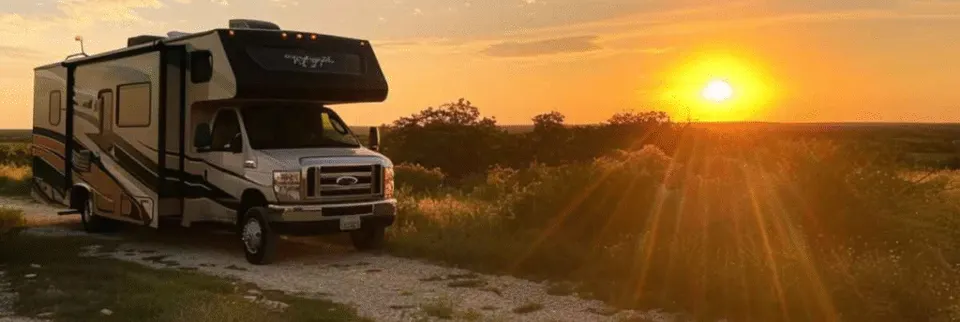
This is our backyard, and it is the most underrated camping in Texas for anyone who lives in the Metroplex. You get rivers, clear lakes, dinosaur tracks, and a brand-new state park, all without fighting I-35.
The most famous camping in Texas, and the most crowded. Garner State Park on the Frio is the summer classic, with 211 water and electric sites and only 12 full-hookup sites at 35 USD.
Inks Lake has 114 water and electric sites at 23 USD and the Devil's Waterhole swim spot. Pedernales Falls lists 69 water and electric sites at 20 USD. Book months out for summer weekends.
Some of the darkest night skies in the country and the most remote camping in Texas. Go between November and March. Fill fuel and water tanks every chance you get, because services are hours apart, and reserve early for the limited RV sites inside the national park.
Palo Duro Canyon is the showpiece, with about 97 water and electric sites at 26 USD across its campgrounds, per Texas Parks and Wildlife. Caprock Canyons is quieter, with bison roaming the park. Lake Meredith is the best free camping in the region: the National Park Service says all its campgrounds are free except the reservable RV sites at Sanford-Yake.
Beach camping is the draw. At Padre Island National Seashore, beach camping is free with a permit plus the entrance fee, with a 14-day limit. Coastal wind and salt are rough on awnings and slide seals, so rinse the rig when you leave.
East Texas trades views for shade: Caddo Lake's cypress swamps, Tyler State Park, and four national forests with free dispersed camping. The lakes around Dallas, Fort Worth, and Waco are the closest camping in Texas for city families, which is exactly why they sell out first on spring weekends.
For a statewide Texas RV parks map, the most reliable source is the interactive state park map on the Texas Parks and Wildlife website, plus a private-park directory for everything else. For the stretch we know best, here is the corridor in driving order, heading west.
To see every site and the barndominium at our park before you arrive, open the Inez Spring park map. For every RV park on the interstate, with midpoints and fuel stops, see our I-20 RV parks corridor guide and the park-by-park list of RV parks along I-20 in Texas, with the mile gaps between them. Traveling with a dog? Our guide to pet friendly RV parks in Texas covers leash rules and heat.
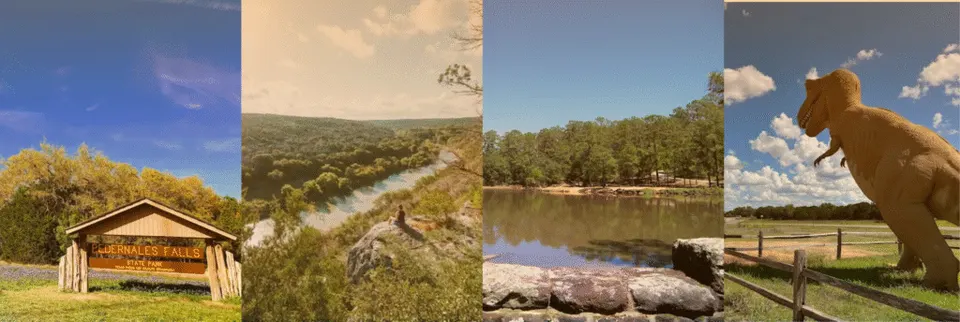
Plenty of people search for RV camping in Central Texas, and the answers online are a mess, so here is a clear line. Central Texas usually means the Austin, Waco, and Hill Country region, from about Temple and Belton south to San Marcos and west into the Hill Country.
The strong Central Texas RV parks and campgrounds there are Inks Lake, Pedernales Falls, Colorado Bend, and Garner state parks, plus the Corps of Engineers lakes around Georgetown and Belton. Private resorts cluster around New Braunfels, Canyon Lake, and Fredericksburg.
Earlier versions of this page called Eastland a Central Texas base. That was wrong, and we fixed it.
Eastland sits on I-20 about 1 hour 35 minutes west of Fort Worth and about 50 minutes east of Abilene, in the Cross Timbers. If you want the Hill Country, plan on 2.5 to 4 more hours south. If you want rivers and lakes without the Hill Country crowds, the I-20 West section above is your map.
| Season | Go here | Avoid or plan around |
|---|---|---|
| March to May | Hill Country wildflowers, I-20 West state parks, Piney Woods | Spring break sellouts; fast-moving storms and flash floods |
| June to August | Rivers and lakes: Frio River, Possum Kingdom, Inks Lake | Big Bend and open desert; midday hiking anywhere |
| September to November | Panhandle canyons, Hill Country, I-20 West, the coast after hurricane season | Peak Gulf hurricane weeks in September; burn bans in dry years |
| December to February | Big Bend, the Rio Grande Valley, the coast, long stays anywhere mild | Panhandle freezes; ice storms that can shut down stretches of I-20 |
Heat, storms, and flash floods are the real hazards of camping in Texas. Our Texas RV camping safety guide covers what to do when a storm cell rolls in, and our RV camping checklist for Texas breaks the gear list down season by season.
Every trip mixes these three. Here is what each actually costs and gives you, using posted fees.
| Type | Typical posted nightly fee | Hookups | Strength | Weakness |
|---|---|---|---|---|
| Free public land | 0 USD | None | Solitude, cost | No water, power, or dump; limited sites; 14-day limits |
| Corps of Engineers lakes | 8 to 28 USD (Proctor Lake) | None to full, by loop | Cheapest hookups in the state | Seasonal loop closures |
| Texas state parks | About 15 to 35 USD plus a daily entrance fee | Mostly water and electric; few full hookups | Scenery, trails, water access | Weekend sellouts; small full-hookup loops |
| Private RV parks | About 40 USD and up; Inez Spring from 40 USD | Full hookup, 30/50 amp | Sewer, laundry, late check-in, more sites | Fewer trails than a big state park |
Sources: Texas Parks and Wildlife campsite pages for each park named in this guide, and the U.S. Army Corps of Engineers Proctor Lake camping page, checked October 2026.
If cost is the main filter, our guide to free camping in Texas and the cheap backups lists every legal free spot we could verify, with a ladder from free to full hookup.
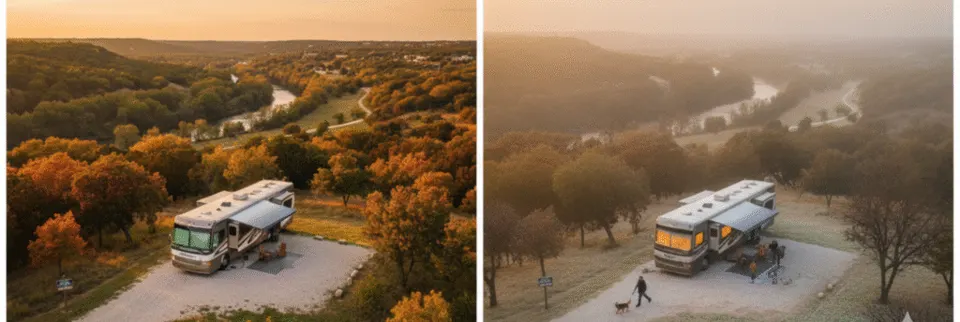
This page is the hub. Each guide below goes deep on one piece of planning a trip.
Here is the problem with a state-park-only trip in this part of the state. The parks are excellent, but their full-hookup loops are tiny, and on a spring or summer weekend the water and electric sites go fast. If you are running a 40-foot rig or need sewer for a week, you can spend more time refreshing a reservation page than planning the trip.
A private basecamp on the interstate fixes that. You hook up once, then day-trip to the parks with the truck. From Exit 343, these are our estimated drive times:
| Day trip from Inez Spring | Drive (est.) | Why go |
|---|---|---|
| Lake Leon | About 10 minutes | Bass fishing, boat ramps |
| Palo Pinto Mountains State Park | About 30 minutes | New trails, Tucker Lake |
| Abilene | About 50 minutes | Frontier Texas, the zoo, Abilene State Park |
| Possum Kingdom | About 1 hour | Clear water, cliffs |
| Dinosaur Valley State Park | About 1.5 hours | Dinosaur tracks in the riverbed |
Our Dinosaur Valley day-trip guide covers when the tracks show. And to be clear about what we are not: we are not in the Hill Country, and we are not a theme resort. We are a quiet 24-acre park on the Leon River, and that is the point.
Picture a Tuesday in late April. You spent the morning on the trails at Palo Pinto Mountains, you are back at your site by 2, and the only question left is whether to fish Lake Leon at sunset or sit by the river with a cold drink. Nobody had to pack up camp to see something new.
Here is what your site comes with:
Site types include pull-through, back-in, and cliffside sites. The homepage lists cliffside sites at 40 USD and pull-throughs at 45 USD a night, so a big rig that needs a pull-through costs only a few dollars more. Not sure which fits your rig? Ask the front desk at (254) 629-1197.
Guests rate us 4.8 stars on 222 Google reviews, as of October 2026. In one guest's words: "quiet nights, friendly community, convenient I-20 access." Staying a month or the winter? See our monthly RV sites, from 500 USD plus metered electric. Check open dates and book your site.
By region: Garner, Inks Lake, and Pedernales Falls in the Hill Country; Big Bend and the Davis Mountains in the far west; Palo Duro Canyon and Caprock Canyons in the Panhandle; Padre Island on the coast; Caddo Lake and the national forests in the Piney Woods; and Dinosaur Valley, Palo Pinto Mountains, Possum Kingdom, and Lake Leon along I-20 west of Fort Worth. Pick by season and drive time first.
For most of the state, October, November, March, and April are the most comfortable months for camping in Texas, with mild days and cool nights. Summer works near water, like the Frio River, Possum Kingdom, or Lake Leon. Winter is prime time for the Rio Grande Valley, Big Bend, and the coast, while the Panhandle can see snow and hard freezes.
Texas Parks and Wildlife publishes an interactive map of every state park on its website, and RV directories map private parks statewide. For the I-20 corridor from Fort Worth to Abilene, this guide lays out the stops in driving order, and our park map shows every site at Inez Spring, Exit 343 in Eastland, including pull-throughs, tent sites, and the barndominium.
For weekends, holidays, spring break, and summer, yes. Popular parks often fill, and the best sites go first: Garner State Park lists only 12 full-hookup sites, and Abilene State Park lists 3. Book through Texas State Parks as early as the window allows, and remember that every state park campsite fee is charged on top of the daily entrance fee.
Central Texas usually means the Austin, Waco, and Hill Country region. Strong RV picks there include Inks Lake State Park near Burnet, Pedernales Falls near Johnson City, Garner State Park on the Frio, and the Corps of Engineers lakes around Georgetown and Belton. Eastland and the I-20 corridor sit farther north, about 1 hour 35 minutes west of Fort Worth, and are not Central Texas.
Yes, in a limited number of places, because about 95 percent of Texas is private land and there is no open BLM land. Free options include most campgrounds at Lake Meredith National Recreation Area, dispersed sites in the national grasslands and East Texas national forests, and Padre Island beach camping with a free permit plus entrance fee. Our free camping guide lists the rules.
Texas is too big to see in one trip, and that is the good news. Run the Three-Question Filter, pick one region, and book the hookups before the weekend crowd does. The best camping in Texas is the trip you can actually reach by Friday dinner.
Inez Spring sits at Exit 343 in Eastland. The booking pages and the park guides for the corridor.